You Won’t Believe This City Built in a Mine Valley
Nestled in a dramatic canyon carved by ancient volcanic activity, Guanajuato, Mexico, looks like something straight out of a dream. I’ve seen many mountain towns, but none shaped by terrain quite like this. The city clings to steep slopes, with colorful houses stacked like LEGO bricks and roads twisting underground through old mining tunnels. It’s no wonder UNESCO gave it World Heritage status. This is not just a destination—it’s a living testament to how landscape can shape culture, architecture, and soul.
The Terrain That Defies Expectations
Guanajuato’s most defining feature is not its colonial architecture or artistic heritage, but the rugged geological stage upon which it was built. Unlike most historic cities that unfold across flat plains or gentle hills, Guanajuato is cradled within a narrow, V-shaped valley formed by long-dormant volcanic forces. The surrounding mountains, rich with mineral veins, rise sharply on all sides, leaving little room for expansion. As a result, the city does not spread outward—it climbs upward. Its streets follow the natural folds of the earth, curving and tilting with the land’s contours, creating a layout that feels both spontaneous and inevitable.
This topographical constraint shaped Guanajuato’s urban evolution in profound ways. Rather than imposing a rigid grid, early settlers allowed the terrain to guide construction. Houses were placed where stability allowed, often terraced into the hillside like steps on a staircase. Pathways wind unpredictably, sometimes doubling back on themselves, while staircases appear without warning, connecting homes that exist on entirely different planes. The city’s irregularity is not a flaw—it is a response, a dialogue between human ingenuity and natural resistance. What might have been seen as an obstacle became the foundation of a unique urban identity.
Even today, visitors are struck by how the city seems to defy conventional logic. Buildings perch on inclines that appear too steep to support them. Roads vanish into tunnels only to reemerge at unexpected elevations. This organic growth, dictated by geology rather than planning, gives Guanajuato a sense of authenticity rarely found in modern cities. It is a place where nature was not subdued but respected, where every architectural decision was shaped by the unyielding presence of the land.
A City Shaped by Silver and Slopes
The story of Guanajuato is inseparable from silver. In the 16th century, Spanish explorers discovered vast deposits of the precious metal beneath the mountains, triggering a mining boom that would define the region for centuries. What began as a modest mining camp quickly grew into one of the most important economic centers in New Spain. At its peak, Guanajuato produced nearly two-thirds of the world’s silver, fueling empires and drawing fortune seekers from across the globe.
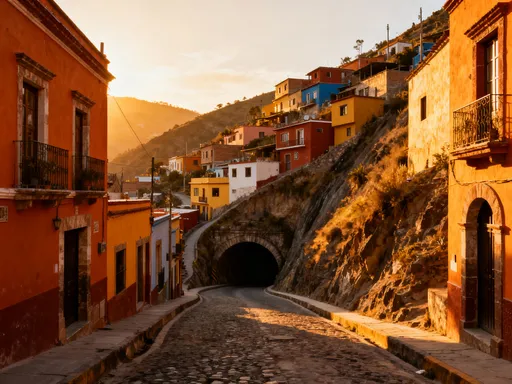
But the riches lay deep within the earth, and extracting them required digging into the very bones of the mountains. As miners tunneled through rock, they left behind a network of underground passages. Over time, these tunnels took on new life. When surface roads proved too narrow and steep for growing traffic, city planners had a bold idea: repurpose the old mining shafts into subterranean streets. Today, more than 18 of these *calles subterráneas* run beneath the city, carrying vehicles through what were once veins of silver ore.
This transformation—from mine to infrastructure—speaks to Guanajuato’s adaptive spirit. The same geological forces that made mining possible also dictated how people lived above ground. With flat land at a premium, homes were constructed directly into the hillsides, often using leftover rock from the mines as building material. Entire neighborhoods emerged along ridgelines, each house clinging to the next, forming a patchwork of color and texture against the gray stone. The legacy of silver is visible not only in museums and historic mines like La Valenciana, but in the very fabric of daily life.
Walking through Guanajuato, one senses the weight of history in every step. The city’s prosperity was built on extraction, but its survival depended on innovation. It is a reminder that wealth is not just measured in metal, but in the resilience of a community that learned to thrive within the limits of its environment.
Colorful Architecture Meets Geological Reality
From a distance, Guanajuato appears as a cascade of color spilling down the canyon walls. Homes painted in vivid pinks, sky blues, sunflower yellows, and emerald greens glow under the high-altitude sun, creating a visual spectacle that feels almost surreal. While many assume this chromatic abundance is purely artistic, it is in fact deeply rooted in practical necessity. The steep slopes and unstable soil made wide plots impossible, forcing builders to work vertically and creatively.
Homes were constructed on narrow, irregular parcels, often with multiple entrances at different elevations. A family might enter from a street at the top of a hill, while another door on the opposite side opens to a lower alley, accessible only by staircase. This vertical stacking maximized usable space while minimizing the risk of landslides. The result is a city where architecture and topography are in constant conversation—where every window, balcony, and rooftop is positioned for both function and view.
Balconies, often adorned with potted plants and hanging textiles, serve as outdoor living rooms, offering residents a private vantage point over the valley. Rooftop terraces become gathering spaces for families and neighbors, especially during festivals when music and laughter echo through the canyon. These elevated platforms are not just aesthetic—they are essential to social life in a city where horizontal space is scarce.
Amid this vertical sprawl, the few flat areas take on special significance. Plazas like Jardín de la Unión and Plaza de la Paz serve as communal hearts, where locals gather for coffee, conversation, and live music. These open spaces provide visual and emotional relief from the surrounding density, acting as anchors in a city that otherwise feels like it’s climbing into the sky. The contrast between the orderly plazas and the chaotic hillside neighborhoods underscores Guanajuato’s duality: a place of both constraint and creativity, limitation and beauty.
Navigating a Labyrinth of Levels and Tunnels
Exploring Guanajuato is less like touring a city and more like navigating a three-dimensional puzzle. There are no straight lines, few flat stretches, and almost no orientation points that remain constant. One moment you’re walking along a cobblestone street, and the next you’re descending a steep staircase that leads to an alley barely wide enough for two people to pass. The city demands attention, rewarding those who move slowly and observe closely.
For drivers, the solution to this complexity lies beneath the surface. The network of underground tunnels handles the majority of vehicle traffic, keeping the historic center largely pedestrian-friendly. These tunnels, originally carved to divert floodwaters from the mines, were widened and paved in the 20th century to accommodate cars. Driving through them feels surreal—streetlights flicker above, the walls are rough-hewn rock, and exits emerge unexpectedly into daylight at different levels of the city. First-time visitors often find themselves disoriented, unsure whether they’ve gone up or down.
For pedestrians, the challenge is equally real. GPS signals frequently drop in the deep canyon, making digital maps unreliable. Instead, travelers must rely on physical signage, paper maps, and the kindness of locals. Fortunately, residents are accustomed to guiding visitors and take pride in explaining the city’s quirks. Many neighborhoods are connected by hidden staircases, secret passageways, and small elevators known as *ascensores*, which transport people between major levels with minimal effort.
One of the most memorable experiences is walking from the lower city to the Mirador de los Picachos, a viewpoint offering a panoramic vista of Guanajuato at sunset. The journey involves climbing hundreds of steps, winding through quiet barrios, and emerging suddenly above the rooftops. It is exhausting, yes, but also deeply satisfying—a physical reminder of the city’s vertical nature. In Guanajuato, movement is not just transportation; it is part of the experience.
Why This Landscape Creates a Unique Cultural Vibe
The physical isolation created by Guanajuato’s terrain has fostered a cultural richness that is both intimate and resilient. Because many neighborhoods are separated by steep slopes and winding paths, they have developed distinct identities over time. Each *barrio*—whether it’s San Javier, Pastita, or Alhondiga—has its own rhythm, traditions, and local pride. Festivals are neighborhood affairs, often centered around a parish church, and passed down through generations.
One of the most celebrated events is the Festival Internacional Cervantino, a month-long arts festival that transforms the city into a stage. Performances take place in plazas, theaters, and even underground tunnels, with music echoing off canyon walls in unexpected ways. The natural acoustics of the valley amplify sound, turning street musicians into impromptu concert performers. During these weeks, Guanajuato pulses with energy, drawing artists and audiences from around the world, yet never losing its local soul.
The closeness of homes also nurtures strong community bonds. It is common to see neighbors chatting across rooftops, sharing meals over shared walls, or celebrating birthdays in communal courtyards. This proximity, born from necessity, has cultivated a warmth and generosity that visitors often remark upon. In a world where urban life can feel anonymous, Guanajuato offers a different model—one where geography fosters connection rather than isolation.
Even daily routines reflect this intimacy. The *panadero* (bread seller) knows which households prefer sweet rolls, the corner store owner greets customers by name, and children play in alleys under the watchful eyes of multiple adults. These small acts of familiarity are not incidental—they are the product of a city where life unfolds in layers, both physical and social. The terrain may have divided the city into pockets, but it also brought people closer together in ways that flat cities rarely achieve.
Travel Tips for Exploring the Terrain Wisely
Visiting Guanajuato is a joy, but it requires preparation. The most important item in your suitcase? A pair of comfortable walking shoes. The city’s cobblestone streets, uneven steps, and constant elevation changes demand sturdy footwear. Sandals or dress shoes may look stylish, but they will make your journey far more difficult. Opt for supportive sneakers or hiking shoes with good grip to handle the slick stones, especially after rain.
Timing your visit can also enhance your experience. Mornings are ideal for sightseeing, when the air is cool and the sunlight casts long shadows across the hills, highlighting the textures of the architecture and landscape. By midday, the sun can be intense due to the city’s elevation—approximately 2,000 meters (6,500 feet) above sea level. The dry climate means heat builds quickly, so plan indoor activities like museum visits for the afternoon.
To minimize physical strain, take advantage of the city’s public elevators. The *Ascensor del Pípila* and *Ascensor de la Paz* connect upper and lower neighborhoods, saving visitors from grueling climbs. These elevators are inexpensive, reliable, and offer scenic views during the ascent. Similarly, the funicular railway near the University of Guanajuato provides another energy-saving option for moving between levels.
Accommodation choices matter. Staying in the historic center—near Jardín de la Unión or Teatro Juárez—puts you within walking distance of major attractions, restaurants, and cultural sites. While hotels on the outskirts may be cheaper, the daily trek uphill can be exhausting, especially after a full day of exploration. Consider boutique inns or family-run guesthouses, which often offer personalized service and local insights.
As for transportation, avoid renting a car unless absolutely necessary. Parking is extremely limited, and the tunnel system can be confusing even for experienced drivers. Instead, rely on walking, taxis, or the local bus system. Taxis are widely available and affordable, and many drivers are happy to provide mini-tours or recommendations. If you do drive, enter the tunnels slowly, follow directional signs carefully, and be prepared for one-way routes and tight turns.
Finally, stay hydrated. The high altitude can cause fatigue or mild dizziness, especially for those coming from sea level. Drink plenty of water, take breaks when needed, and listen to your body. With thoughtful planning, your visit to Guanajuato can be as comfortable as it is unforgettable.
Guanajuato’s Legacy: Where Nature and Human Spirit Converge
Guanajuato stands as a powerful example of how human creativity can flourish within natural constraints. What could have been a disadvantage—the steep, unstable terrain—became the source of its greatest strength. The city did not fight the land; it listened to it. It built not on top of the earth, but with it, shaping homes, streets, and communities in harmony with the mountain’s form.
This philosophy of adaptation is more relevant today than ever. As cities around the world face challenges from climate change, overcrowding, and environmental degradation, Guanajuato offers a model of sustainable coexistence. It shows that beauty and functionality are not mutually exclusive, and that working with nature—not against it—can yield extraordinary results.
The city’s legacy extends beyond architecture and urban planning. It is a living archive of resilience, innovation, and cultural continuity. Artists, writers, and musicians have long been drawn to its energy, finding inspiration in its colors, sounds, and rhythms. Students from the University of Guanajuato add youthful vitality, while elders preserve traditions in quiet corners of the barrios. This blend of old and new, local and global, gives the city a dynamic yet grounded character.
For the traveler, Guanajuato is more than a destination—it is an experience of place. It invites you to slow down, to climb, to look closely, and to connect. It reminds us that the most memorable journeys are not always the easiest, and that the places that challenge us often leave the deepest impressions. In a world that increasingly values speed and convenience, Guanajuato stands apart—a city built not despite the land, but because of it. Its terrain is not just special. It is sacred.