Whispers of Stone: Walking Through Ephesus’ Forgotten Grandeur
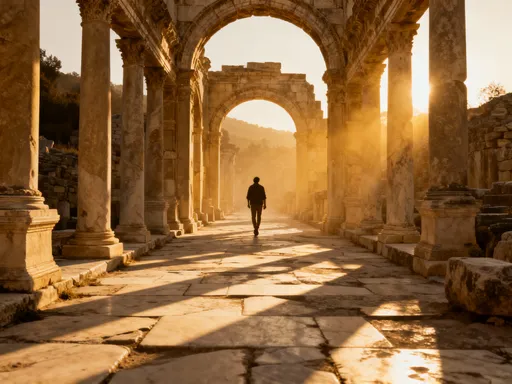
Have you ever stepped into a place where time stands still? Ephesus, Turkey, isn’t just ruins—it’s a living echo of ancient ambition, carved in marble and shadow. I walked its marble streets as the sun gilded temple columns, and honestly, nothing prepares you for the scale, silence, and sheer artistry. This isn’t just history—it’s architecture that breathes. The air carries the scent of sun-warmed stone and wild herbs, and beneath your feet, centuries-old marble bears the faint grooves of chariot wheels. In this quiet expanse, where philosophers once debated and pilgrims paused on sacred journeys, every column, arch, and mosaic tells a story not of loss, but of endurance. Ephesus invites not just sightseeing, but a deeper kind of listening.
Arrival & First Impressions – Stepping Into Another World
The journey to Ephesus begins with a subtle shift in atmosphere. As you leave the coastal town of Selçuk and approach the archaeological site, the modern world begins to soften. The road narrows, flanked by olive groves and dry stone walls, until the first glimpse of ancient columns rises from the hillside like sentinels of time. The scent of thyme and dried earth lingers in the air, mingling with the warmth of limestone under the Aegean sun. This sensory transition is intentional—Ephesus was built not just for function, but for impression. The entrance, located near the lower city, opens onto a wide marble road that stretches into the distance, flanked by the remains of colonnades and public buildings. It is here, at this threshold, that visitors first feel the weight of history.
Timing your arrival can transform the experience. Early morning, between 8 and 10 a.m., offers the softest light and the fewest crowds. The golden glow at sunrise bathes the Library of Celsus in a warm hue, making it one of the most photographed moments in the ancient world. Tickets can be purchased at the main gate or online through the official Turkish Ministry of Culture and Tourism website, which also provides information on guided tours and audio guides. A combined ticket that includes the Ephesus Museum and the House of the Virgin Mary is recommended for those seeking a fuller understanding of the region’s historical and cultural layers.
To avoid the midday heat and the surge of tour groups, arriving early also allows for a more contemplative pace. The site covers approximately 1.5 square kilometers, and while major landmarks are well-marked, the true magic lies in wandering with intention. Comfortable walking shoes are essential—the marble streets, though beautiful, can be uneven and slippery in places. Sun protection, water, and a light hat are practical necessities, especially during the summer months when temperatures rise above 30°C. Yet, even in the heat, the open sky and the rhythm of the ruins create a meditative space, where the past feels not distant, but present.
The Library of Celsus – Where Knowledge Met Drama
Standing at the end of the Marble Street, the Library of Celsus rises like a portal between worlds. Though only the façade remains fully reconstructed, its grandeur is undiminished. Built in the 2nd century AD in honor of Tiberius Julius Celsus Polemaeanus, a Roman senator, the library once housed around 12,000 scrolls. It was both a tomb for Celsus and a monument to knowledge—a rare fusion of personal legacy and public service. The two-story façade, adorned with Corinthian columns and intricate reliefs, showcases a masterful blend of Roman engineering and Greek artistic sensibility. The niches that once held statues of Wisdom, Intelligence, Valor, and Beauty still command attention, their symbolic presence echoing the values of the era.
What makes the Library of Celsus particularly striking is its theatricality. The design was meant to impress, not just inform. The play of light across its surface changes throughout the day—soft and golden at dawn, sharp and sculptural at noon, and warm and diffused in the late afternoon. This interplay enhances the sense of depth and movement in the architecture, drawing the eye upward toward the ornate pediment. Behind the façade, the interior was destroyed by fire and earthquake centuries ago, but the ruins suggest a semicircular reading hall where scholars once gathered in quiet contemplation.
Restoration work completed in the 1970s used original fragments wherever possible, reassembling the façade like a three-dimensional puzzle. This careful reconstruction allows modern visitors to grasp the building’s original scale and elegance. Unlike many ancient sites where imagination must fill vast gaps, Ephesus offers a rare clarity. The Library of Celsus stands as a testament to the enduring value placed on learning and memory. It reminds us that knowledge was not merely stored here—it was celebrated, enshrined in stone for future generations to witness.
Marble Street – The Beating Heart of Ancient Urban Life
The Marble Street, or Curetes Street, was the central artery of Ephesus, connecting the harbor to the heart of the city. Walking its length today, one can still feel the pulse of ancient urban life. The smooth, polished marble blocks underfoot have been worn by centuries of footsteps—merchants leading donkeys laden with goods, philosophers in flowing robes, Roman soldiers on patrol, and pilgrims seeking spiritual solace. This was not a silent path but a vibrant corridor of commerce, conversation, and culture. Along its edges, the foundations of shops, fountains, and public latrines remain, offering glimpses into the rhythm of daily existence.
What sets the Marble Street apart is its sophistication. Built during the reign of Emperor Augustus and later paved with marble under Emperor Nero, the road was designed for both beauty and function. A covered colonnade once shaded pedestrians from sun and rain, while an advanced drainage system beneath the surface channeled stormwater efficiently. Lamps placed along the street provided illumination at night, a rare luxury in the ancient world that signaled Ephesus’ status as a major urban center. These features reflect a level of city planning far ahead of its time, where public comfort and civic pride were deeply intertwined.
The street also reveals the social stratification of the city. The width of the road allowed for processions and parades, while side paths accommodated different classes of citizens. Public fountains, known as nymphaea, served both practical and symbolic purposes—providing fresh water while showcasing the city’s wealth through elaborate sculptures and mosaics. The placement of shops suggests a carefully organized marketplace, where artisans sold pottery, textiles, and spices. Even the wear patterns on the marble tell stories: deeper grooves near intersections indicate heavy cart traffic, while smoother sections suggest areas of frequent pedestrian use. In every detail, the Marble Street speaks of a civilization that valued order, hygiene, and beauty in equal measure.
The Terrace Houses – Luxury Carved Into the Hillside
Nestled along the southern slope of Bülbül Dağı (Nightingale Mountain), the Terrace Houses offer a rare glimpse into the private lives of Ephesus’ elite. Often referred to as the “Houses of the Rich,” these multi-level residences were home to wealthy merchants, officials, and aristocrats. Unlike the grand public buildings, these homes reveal a more intimate side of ancient architecture—where artistry met daily living. Access to the Terrace Houses requires a separate ticket, but the experience is well worth it. Wooden walkways allow visitors to peer into the interiors without disturbing the delicate remains, preserving mosaics, frescoes, and even sections of original plumbing.
Each house was built around a central courtyard, a design that promoted ventilation and natural light while maintaining privacy. The walls were adorned with vibrant frescoes depicting mythological scenes, floral patterns, and geometric designs, their colors still surprisingly vivid after nearly two millennia. Floors were decorated with intricate mosaics made from tiny colored stones, illustrating everything from hunting scenes to marine life. One particularly well-preserved mosaic shows a dolphin entwined with a serpent, possibly symbolizing protection or divine favor.
What astonishes modern visitors is the level of comfort and innovation embedded in these homes. Many featured underfloor heating systems, known as hypocausts, where hot air circulated beneath raised floors to warm the rooms above—a precursor to modern central heating. Water was supplied through terracotta pipes connected to the city’s aqueduct system, and some homes even had private latrines with running water. Insulation was achieved through thick stone walls and strategically placed windows that maximized sunlight in winter and minimized heat in summer. These houses were not just luxurious—they were intelligent, designed with a deep understanding of climate, aesthetics, and human needs.
The Great Theater – A Stage for Thousands, Still Standing
Dominating the southern end of the city, the Great Theater of Ephesus is one of the best-preserved ancient theaters in the world. With a seating capacity of over 24,000, it could accommodate nearly half the city’s population, making it a central venue for both entertainment and civic life. Built in the 3rd century BC and later expanded under Roman rule, the theater’s sweeping curve follows the natural contour of the hillside, creating an acoustically perfect space. Even today, a whisper from the stage can be heard in the highest row—a testament to the precision of ancient engineering.
The structure is divided into three main sections: the orchestra, the cavea (seating area), and the scaenae frons (stage building). The orchestra, originally a circular space for choruses and dignitaries, was later modified to include a raised stage. The cavea is segmented into upper and lower tiers, with designated sections for different social classes—senators and officials sat closest to the stage, while ordinary citizens occupied the upper levels. Underground passageways, known as vomitoria, allowed performers and crowds to enter and exit quickly, a feature that influenced modern stadium design.
Beyond its architectural brilliance, the Great Theater was a hub of political and cultural activity. It hosted musical performances, dramatic productions, and public assemblies. Historical records suggest it was also the site of early Christian gatherings, including a possible appearance by the Apostle Paul, whose teachings stirred controversy among local merchants. Today, the theater occasionally comes alive again during summer festivals, where classical music and traditional performances honor its legacy. Standing on the stage, looking out over the vast semicircle of stone seats, one can almost hear the echoes of applause, debate, and song—voices that once shaped the soul of a city.
Temple of Hadrian & Hidden Details – Small Wonders, Big Meaning
While the Library of Celsus and the Great Theater command attention, smaller structures like the Temple of Hadrian reveal the subtleties of Ephesian craftsmanship. Located just off the Marble Street, this elegant temple was dedicated to Emperor Hadrian, who visited Ephesus in the early 2nd century AD. Though partially ruined, its remaining arch and ornate frieze are masterclasses in symbolic storytelling. The curved arch, supported by Corinthian columns, leads to a pronaos (front porch) adorned with intricate reliefs depicting mythological figures and civic virtues.
One of the most remarkable features is the frieze above the entrance, which illustrates the founding myth of Ephesus—the arrival of the Amazons. Other panels show personifications of the seasons, gods, and allegorical figures representing peace, prosperity, and wisdom. These carvings were not mere decoration; they communicated ideals of governance, divine favor, and cultural identity. The blend of Roman imperial imagery with local traditions reflects Ephesus’ role as a cultural crossroads.
Nearby, remnants of stoas—covered walkways with columns—hint at the city’s extensive public infrastructure. These shaded corridors provided shelter and space for social interaction, functioning as ancient equivalents of modern arcades or promenades. Other overlooked details include inscribed boundary stones, drainage grates shaped like lion heads, and repurposed architectural fragments embedded in later walls. These small elements, often missed by hurried tourists, reveal a city that valued precision, symbolism, and continuity. In the Temple of Hadrian and its surroundings, one sees how even modest structures were designed with purpose and pride.
Beyond the Main Path – Quiet Corners With Architectural Soul
Most visitors follow the well-trodden route from the Library to the Theater, but some of Ephesus’ most profound moments await off the beaten path. The Fountain of Trajan, tucked away near the upper city, is a serene masterpiece of symmetry and symbolism. Built in the 2nd century AD, it features a two-story façade with niches that once held statues, surrounded by a pool that reflected the sky. Though partially ruined, its harmonious proportions and delicate carvings evoke a sense of tranquility rarely found in larger monuments.
Further along, the remains of public baths, gymnasiums, and residential blocks offer quieter contemplation. These spaces, stripped of grandeur but rich in texture, invite a slower kind of seeing. Here, one notices the way light falls across a broken column, the curve of a forgotten arch, or the pattern of lichen on weathered stone. These details speak of resilience—of a civilization that built to last, even if time has claimed much of its form.
Exploring these quieter areas requires patience and respect. The site is protected by Turkish law, and touching or climbing on ruins is prohibited. Yet, with mindful observation, even the smallest fragment—a carved capital, a section of mosaic floor, a drainage channel—can spark imagination. Carrying a sketchbook or camera encourages deeper engagement, allowing one to capture not just images, but impressions. These hidden corners remind us that Ephesus was not just a collection of monuments, but a living city, shaped by generations of hands, dreams, and daily rituals.
Why Ephesus’ Stones Still Speak
Ephesus endures not because it is perfectly preserved, but because it is profoundly human. Its stones are not silent relics, but messengers from a civilization that sought order, beauty, and permanence. Every column, arch, and mosaic reflects a deliberate choice—an intention to build not just for utility, but for meaning. The city’s architects understood that space shapes experience, that beauty fosters dignity, and that legacy is written in stone as much as in memory.
To walk Ephesus is to engage in a quiet dialogue across time. It asks us to slow down, to look closely, and to recognize the continuity of human aspiration. The same sun that once lit the scrolls in the Library of Celsus now warms the shoulders of modern travelers. The same marble that bore the footsteps of philosophers now carries our own. In this exchange, Ephesus transcends archaeology—it becomes a mirror, reflecting our enduring desire to create, to connect, and to leave something behind.
For those who visit, the lesson is clear: true grandeur is not in scale alone, but in thoughtfulness. It is in the curve of a staircase that considers the human foot, the placement of a window that captures the morning light, the carving of a god that expresses hope. Ephesus invites us not just to admire, but to listen. And if we do, we may hear, beneath the wind and the silence, the whisper of those who came before—reminding us that even in ruin, there is resonance, and in stone, there is soul.